We only had a short time in Bolzano, but we managed to fit in a lot of different kinds of food, some old favorites and some explorations.
Bolzano’s history is complicated, and it’s hard to come up with a short version. Since this post is about food, I’ll focus on the parts that are culinarily relevant. First, Bolzano and the surrounding region, South Tyrol, has a strong Austrian heritage, and it was part of Austria and related entities for centuries. After WW I, South Tyrol became part of Italy, and there was an influx of people from the rest of Italy, mainly to the larger towns, and especially to Bolzano, the provincial capital. Italy’s cuisine is quite varied, and people from the different areas brought their cuisines with them. Add in modern travel and tourism and the result is quite a variety of food. In just a day, we couldn’t possibly try everything, but we did a good job.
I’ll start with the local dishes in this post, and continue with other dishes in part 2.
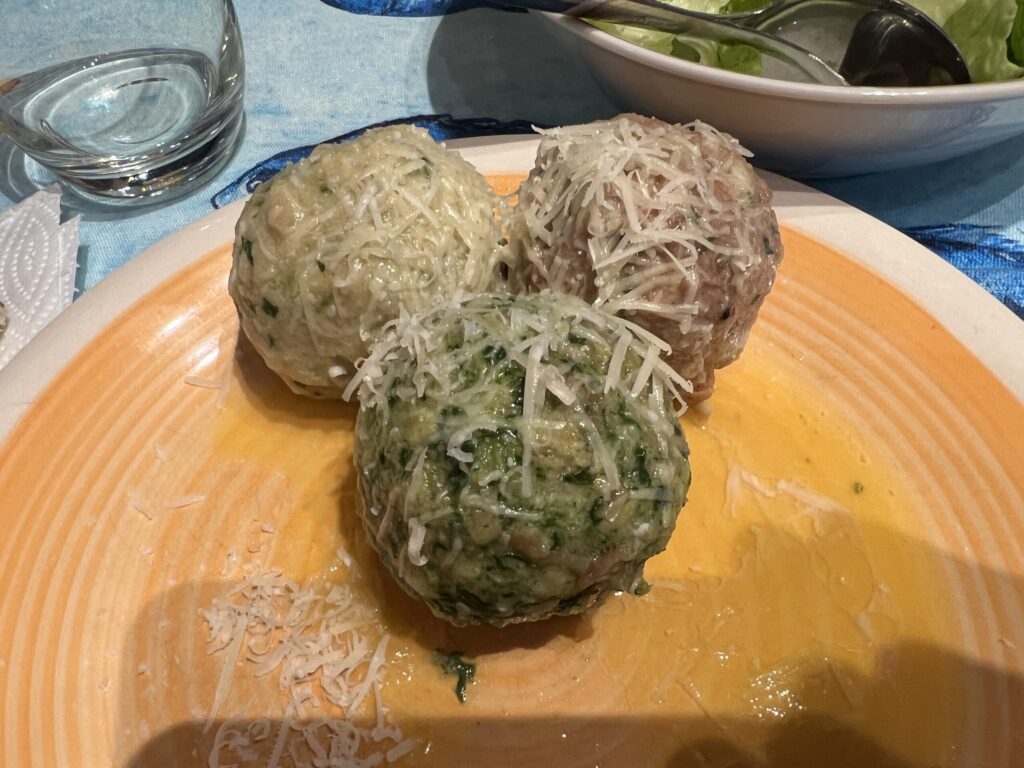
One big local delicacy is Knödel (German) /canederli (Italian). These are hearty bread dumplings with various flavorings, and they can be served in a variety of ways, but we would typically have them with melted butter and cheese. That is in fact how our friend N served them, and we had a “tris” (3). One flavoring was speck (a dry cured ham which we like so much we have been getting it at a deli here in Verona) and herbs. A second one was spinach. A third one was red. I think it was radicchio (maybe N will correct me). In any case, they were all good, and brought back fond memories.
This post is organized by region, not by meal, so we are going to jump to breakfast/coffee the next morning with V (the younger). We went to a bakery that L used to go to on a regular basis, but they have remodeled a bit and now have several tables where you can sit and eat (well, we don’t remember them having tables before, but L would have been focussed on getting bread etc and continuing with the morning shopping).
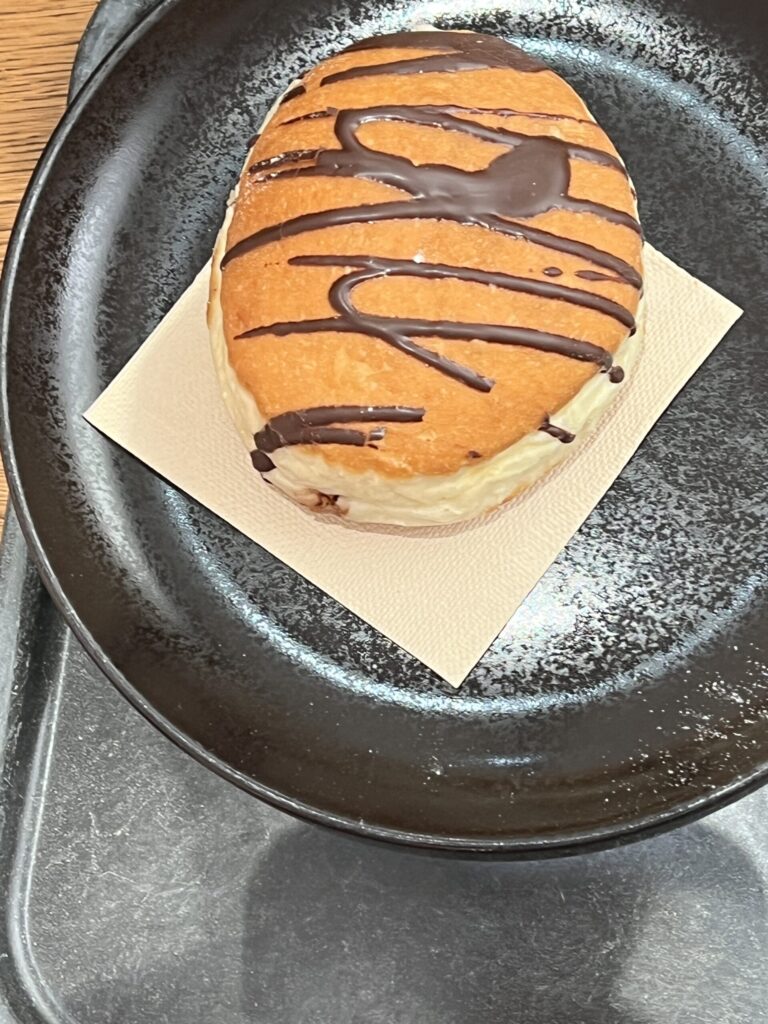
As I went to order, I saw two pleasant surprises. The first one is simple yet complicated, sort of like history of Bolzano. It is a Faschingkrapfen. The simple part is that it is a filled doughnut.
Now let the complications begin!
Krapfen refers to filled doughnuts, in some German speaking areas, like the South Tyrol. They have other names in other areas, like Berliner (but in Berlin they are called Pfannkuchen — very confusing!). Also ring doughnuts are not traditional, and they are called Donuts.
Now, the Fasching part of Faschingkrapfen means Carnival, the pre-Lent period of celebrations and eating all the things one was not supposed to eat during Lent if one was a good Catholic. In South Tyrol and some other places, like Tübingen (Germany) where we lived, Krapfen were available most of the year, but they were limited to fruit or pastry-cream fillings, and they were not really that common to have. However, during Carnival, the Krapfen makers would let loose and come up with all kinds of fancy fillings and decorations.
So it was a surprise to see a Faschingkrapfen at the bakery yesterday, since we are not in the Carnival period. And what made this Krapfen a Faschingkrapfen? From a culinary point, I’d say it’s because of the chocolate filling and decorations. However, it could also be a marketing thing. Maybe one of the locals can fill me in. In any case, L reported that it wasn’t the best example of a Faschingkrapfen (and she knows her Krapfen!). Maybe because it isn’t Fasching?
You may have noticed that I said that L reported on the Krapfen. I was too focused on the other surprise in the bakery case: Buchweizentorte / Torta di grana saracena. This is buckwheat cake with layers of jam, raspberry in this case and topped with confectioner’s sugar. This was my favorite dessert when we lived in Bolzano, and it wasn’t that easy to find — hence my surprise at finding it at this bakery. Definitely fun to have!

Thanks for suggesting this bakery, V!
Now all this talk of food has made me hungry, so part 2 will have to wait. Sorry!
Waiting for N to solve the mistery, I’d bet that the red Knödel (my Ladin grandma called them ‘balote’, little balls) were made with ‘Rohnen’ (‘Randen’ in Switzerland, ‘rote Beeten’ or ‘rote Rüben’ in other German-speaking areas). ‘Beetroot’ is probably an English name understood quite widely. They are my favourite ones and the most difficult ones to prepare at home 🙂
You can find Krapfen all year round by now, as much as we have summer ‘panettone’. We like them, tourists like them, so why not? But the ‘Krapfen’ story is quite complicated. We did not take you to Törggelen, where you eat ‘Bauernkrapfen’ (peasant’s Krapfen), which are fried dough filled with poppy seeds, apricot jam or chestnut cream but flat and squared. They are sometimes described as ‘chiacchiere ripene’ or ‘crostoli ripieni’ to tourists from Northern Italy or Veneto.
All languages with strong regional variation are fun. You order something but never know what you will get when you are far away from home. A friend of mine from Trieste once tried to order a cappuccino and “una pasta” in Rome. She was ordering a croissant, the waiter was picturing a plate of carbonara or spaghetti at 10 a.m. …
Thanks for the clarification, Elena. When we lived in Bolzano, it was hard to find Krapfen except during Carnival; in Tübingen it was easier. But things change with the time and both of those times were quite awhile ago now 🙁. And that’s a fun anecdote about your friend ordering “una pasta” in Rome!
I don’t have anything that extreme, but we we visited Porto, Portugal a few years ago, the first day I went into a pastry shop and ordered two espressos in the “cool” way I had seen in a couple YouTube videos. The clerk politely but firmly said, “We don’t say that here in Porto. It’s only in Lisbon.” Oops. But we got our espressos anyway.